Sunday, 22 August 2021

The Girl from Hell's Passage - Jane Morris


Jane Morris in 1857 DG Rossetti Wikimedia Commons


A one time flower girl whose face became an iconic image of Pre-Raphaelite art, Jane Morris(1839-1914) is best known as  the wife of the Victorian poet and designer William Morris,  and the muse of  the artist DG Rossetti.  With her soulful pensive expression, striking features and cascading hair , she came to represent the archetypical mysterious Pre- Raphaelite beauty. Her story is also one of remarkable reinvention, a rags to riches story. Born and bred in a slum tenement in Oxford, her chance discovery by two artists was the catalyst for an astonishing change in her fortunes. 

 A blue plaque* now marks the location of the run down tenement in the narrow  alley of St Helen's passage, formerly known as Hell's Passage, where Jane  was born on 19th October, 1839. Next door is the historic  inn,  The Turf Tavern, where  a mural of Jane, their erstwhile famous neighbour, is displayed.


 Jane's impoverished parents worked in menial occupations;  her father , Robert Burdon,  was an ostler and her mother washed laundry . Jane's only known occupation was as an occasional flower girl, though she likely helped her mother with the laundry. Probably  destined for a life of menial labour or domestic servitude, Jane's striking looks and a chance encounter at a theatre provided a means to help her escape poverty.

Out at the theatre one night with her sister Bessie, considered by her family to be the prettier of the two, in  September 1857, 18 year old Jane's exotic looks were noted by two artists in the audience, Dante Gabriel Rossetti and Edward Burne Jones, in Oxford to work on  Arthurian themed murals for the Oxford UnionEntranced by her features, a mass of  black hair,  dreamy eyes, and full lips, Rossetti judged her a "stunner" , drew a rough sketch of her and  asked her to model for him . Jane's eventual decision to sit for Rossetti  set in motion events which  changed her life dramatically.

Dante Gabriel Rossetti 

The artist credited with Jane's discovery, DG Rossetti , was well known for his appreciation of "stunners". A key founder of the Pre-Raphaelite movement, which took its inspiration from early renaissance art ( i.e before the artist Raphael), he was also a poet as well as an artist.

Dante Gabriel Rossetti NPG
 When he first encountered Jane, Rosetti was nominally engaged to Elizabeth Siddal, the famed model for Millais's "Ophelia", but the relationship was torturous due to Rossetti's inability to commit to marriage, although he finally married Elizabeth Siddal in 1860. Despite his engagement,  Rossetti was smitten with Jane.  According to the author Hall Caine , Rossetti admitted to him towards the end of his life his guilt that Elizabeth Siddal knew Jane was his true love.

One of the most notorious acts associated with him was the exhumation of his wife's body in Highgate Cemetery in 1869 for the retrieval of his unpublished poetry he had buried with her in 1862. After his wife's death Rossetti became increasingly obsessed with Jane, and despite her marriage to his friend, William Morris, they began a love affair.

William Morris

"it is clear he fell in love with Jane in part of chivalric reasons - the beggar maid whom his love would raise to a much better life"  Jan Marsh Collected Letters of Jane Morris.


William Morris
Working alongside Rossetti on the Oxford Union murals, was aspiring artist William Morris . Wealthy and  energetic , he was also prone to gruffness , loss of temper and angry outbursts, generally short-lived. Speculation exists that Morris's random rages and trances indicated a type of epilepsy, or symptoms of Tourette's syndrome.

 He asked Jane to sit for his work La Belle Iseult As he painted, he fell deeply in love with her.  Given the disparity in their social and economic status, it would not have been unusual in Victorian times for someone of Morris's class  to seek Jane as his mistress, but Morris was a conscientious man, and sought to marry Jane despite the huge gulf in their class, and in defiance of his family's wishes.  Shy and awkward , he declared his love for her on the back of the finished painting writing :"I can't paint you, but I love you   and  proposed to Jane. 

Possibly Jane  preferred the more charismatic Rossetti, but she must have been gratified by Morris's love and proposal. Jane later admitted after Morris's death that she had never loved him, but would likely do the same again. His proposal was simply too good an offer for her to refuse.  There is no evidence to suggest that she did not think highly of him , judging him: " the most magnanimous, the least selfish of men."

Jane's Transformation


La Belle Iseult-
 William Morris


Although he had defied social convention in proposing to Jane,  Morris ensured she received tutoring prior to their marriage  to prepare  her for life as a Victorian gentlewoman. She eagerly embraced the opportunity to reinvent herself from a slum tenement  girl  to a cultivated middle class gentlewoman and proved an apt pupil, becoming competent in piano playing,  needlework, Italian and French and  developing a fondness for reading. 

 Jane's rise from acute  poverty was well known, and on occasion mocked . "Morris-educated" was a term used by Vernon Lee , the author,  in her novel Miss Brown to describe a character clearly based on Jane. Given the class snobbery of the time,  navigating  her way through a new social milieu  must have been daunting for Jane  . In addition to acquiring knowledge and skills,  and no doubt modifying her accent,  she probably also worked on cultivating the  poise, diction and manners appropriate to her new position in life. She is often cited as the proto model for  the character of  cockney Eliza Doolittle in Bernard Shaw's Pygmalion who is coached to fit in to top London society.  Jane appears to have succeeded in her transformation, even noted as having a  "queenly" manner.  Although often described as being silent in company her letters reveal a literate and articulate woman able to socialise and converse easily on many topics with her peers.


Marriage and The Red House 1859-1865 


The Burne Jones
and Morris families NPG


After marriage in 1859 Jane and Morris moved to the newly built Red House in Bexley Heath , commissioned by Morris. Two children  followed: Jenny in 1861 and May in 1862.  A lover of medieval tales, Morris  decided to replicate these in  Arthurian based murals and tapestries in his new home. Rossetti and Burne- Jones , along with their wives, Elizabeth Siddal and Georgiana Burne-Jones all worked together on the project.  Jane , too ,  was given scope to  develop and contribute artistically and creatively working on tapestries and wood engravings.

"Oh, how happy we were, Janey and I, busy in the morning with needlework or wood-engraving"  (Georgiana Burne-Jones Diary)


Red House Painting by Edward Burne- Jones depicting  Sir Degrevaunt's wedding 
 ( William and Jane as bride and groom)
 

Morris  channelled his  artistic talents and  skills into spearheading  an Arts and Crafts movement, He established a home furnishing firm, Morris, Marshall ,Faulkner and Co ( later Morris& Co) in London, with an emphasis on aesthetic beauty and  traditional craftsmanship.  In 1865, he gave up on his idea creating an artistic commune in the Red House, and moved back to London. His  firm became successful and his products increasingly popular  (many iconic wallpaper and textile designs still sold today) . 


A likely example of Jane Morris's work
 https://collections.vam.ac.uk/item/
 Jane proved a skilled embroiderer, designer  and valuable partner, contributing to  many  of the firm's classic designs , and  supervising the firm's  embroidery department and  assignments. A fabric embroidered by her won Morris's company an award in the 1862 International Exhibition

"a quietly assured wife and mother who also played her part in the business, executing and supervising embroidery commissions [. . .]. Quiet in company, she nevertheless had a marked taste for jokes, tall tales, ghost stories and extraordinary dreams, and sensitive sympathy when required, succeeding socially as both hostess and guest, without any desire to shame" Jan Marsh : Dante Gabriel Rossetti


Jane and Rossetti - The Love Triangle 1865 -1876 
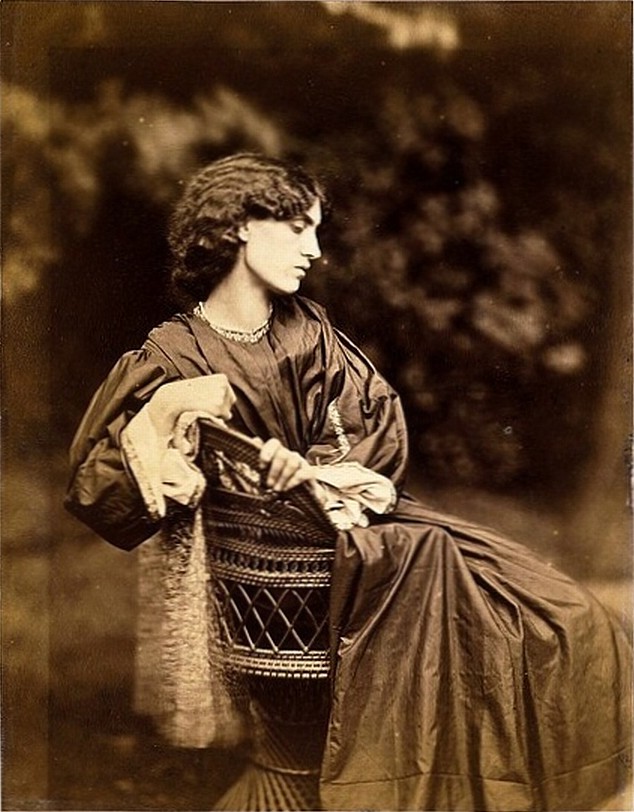
Jane Morris 1865 NPG
After a fraught and difficult marriage,  Rossetti's wife, Elizabeth Siddal, had died of a laudanum overdose in 1862 , widely believed to be suicide . By 1865 Rossetti, now a widower, was living in Cheyne Walk with his "housekeeper" Fanny Cornforth. He  commissioned photographs of  Jane striking various poses in his garden emphasising the aspects of her physiognomy - strong jawed, full lipped, long necked  and big hair  that he found attractive, and  would exaggerate in his  later artistic depictions of her. 

Despite her status as a married woman,  Rossetti openly displayed his affection for Jane; on one occasion spoon-feeding her strawberries  at a dinner party with Morris nearby.  How much Jane encouraged  him is unknown, but time spent as  model and artist  enabled growing intimacy. Their affair is said to have intensified around 1868.  A bracelet design by Rossetti  with the inscription Sept 57 ¤ April 14 1868  has been mooted as marking the dates of their first meeting in Oxford and the start of their  affair (although some authors have questioned how physical their relationship was). 

In typical Victorian fashion, their love affair appeared to precipitate  increasing bouts of ill health in both, perhaps psychosomatically induced.  Jane began to suffer neuralgia and back pain. According to the artist Bell Scott , Rossetti's infatuation with Jane exacerbated his illnesses; a growing hypochondriac since his wife's death,  Rossetti consumed ever - increasing amounts of chloral and whisky,  partly driven by the fear he was going blind  and would be unable to paint. To a large extent his fear of losing his sight  influenced his notorious decision to exhume his wife's grave in 1868 to retrieve  his unpublished poetry manuscripts he had buried with her .

"There remains the mystery of the ill health of Mrs Morris, who took to the sofa in 1869, at the age of twenty-nine, and never really left it"  Fiona McCarthy.


Idyll at Kelmscott Manor

"What other woman could be loved like you, Or how of you should love possess his fill"  Dante Gabriel Rossetti  House of Life 1870 
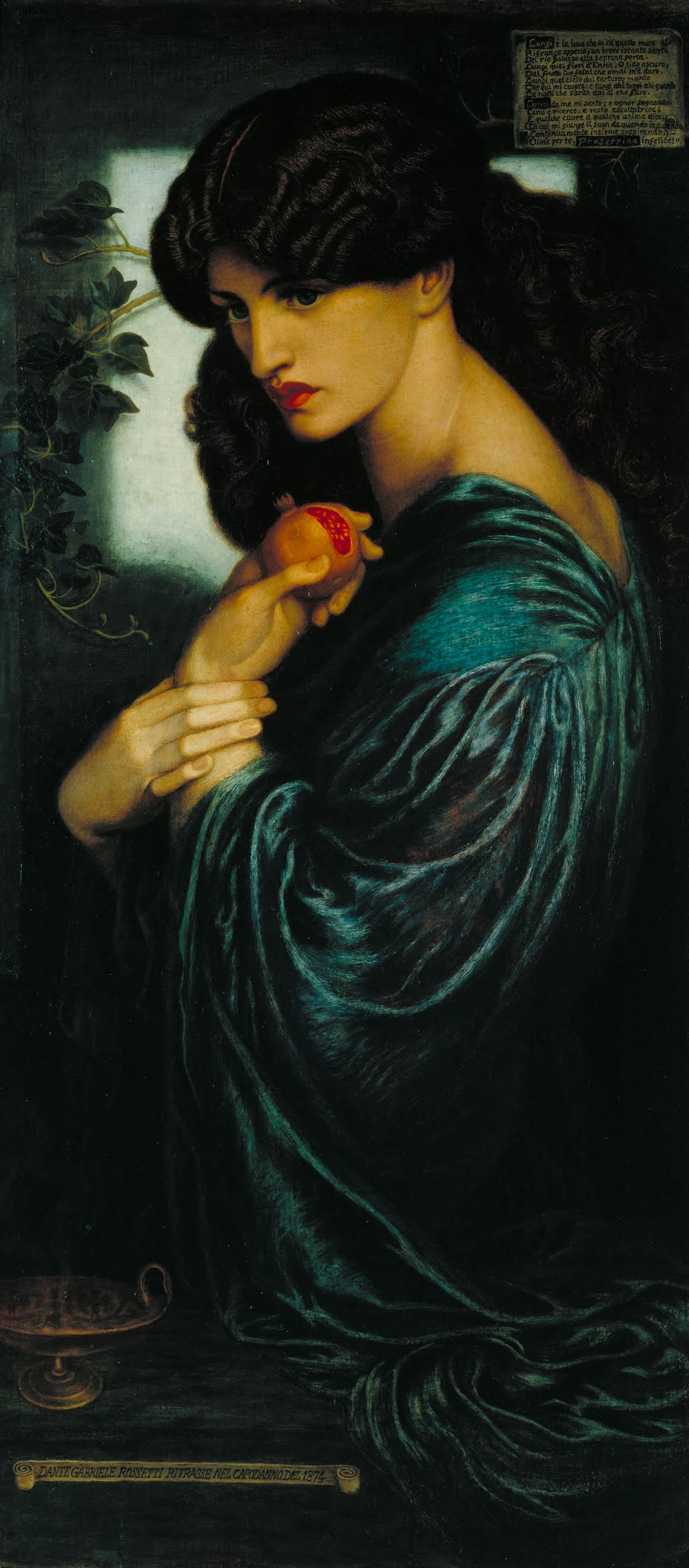
Prosperine
Wikimedia Commons

 " Morris's
 generosity bordered on the sublime" according to the author Fiona McCarthy. No doubt pained by the affair, Morris, either resigned or pragmatic,  appeared  to take steps to enable Rossetti and Jane a free rein .  In 1871  he took out
 a joint  tenancy  with Rossetti on Kelmscott Manor, a picturesque country house near the Thames, and 
conveniently removed himself to Iceland for the first of a number of lengthy trips for research for his literary work. By now he was also a reputed poet and author( and had turned down the post of Poet Laureate) .  Rossetti  was left free to pursue his art, and his affair with Jane at Kelmscott for long interludes under a cloak of respectability and out of the public gaze . 

 From Iceland,  Morris wrote to Jane urging her to be "happy" . Morris's later stated belief that he did not believe in sexual ownership , and sex should only happen where there was " natural desire and kindliness on both sides" may partly explain his actions.  Although they led increasingly separate lives due to Morris's many interests, there is no evidence that Morris reproached Jane or was unfaithful to her.

Jane and Rossetti enjoyed  romantic interludes at Kelmscott over the next couple of years. Despite his ill-health, Rossetti's creativity flourished . He sketched and painted Jane obsessively,  producing sensual and haunting mythological images of her, full of  allusions and messages to their domestic situation. He was also inspired to write sonnets -  which ironically  Morris ( much to his disgust)  had to later review for a publication.

There is something appalling,.... in looking at a whole series of Rossetti’s images, more and more obsessive yet essentially all the same, brooding, dangerous, sexually greedy, too much. The best, and therefore the worst, is Proserpine.” AS Byatt -Peacock and Vine 


The Ending of The Affair and  Rossetti's Decline
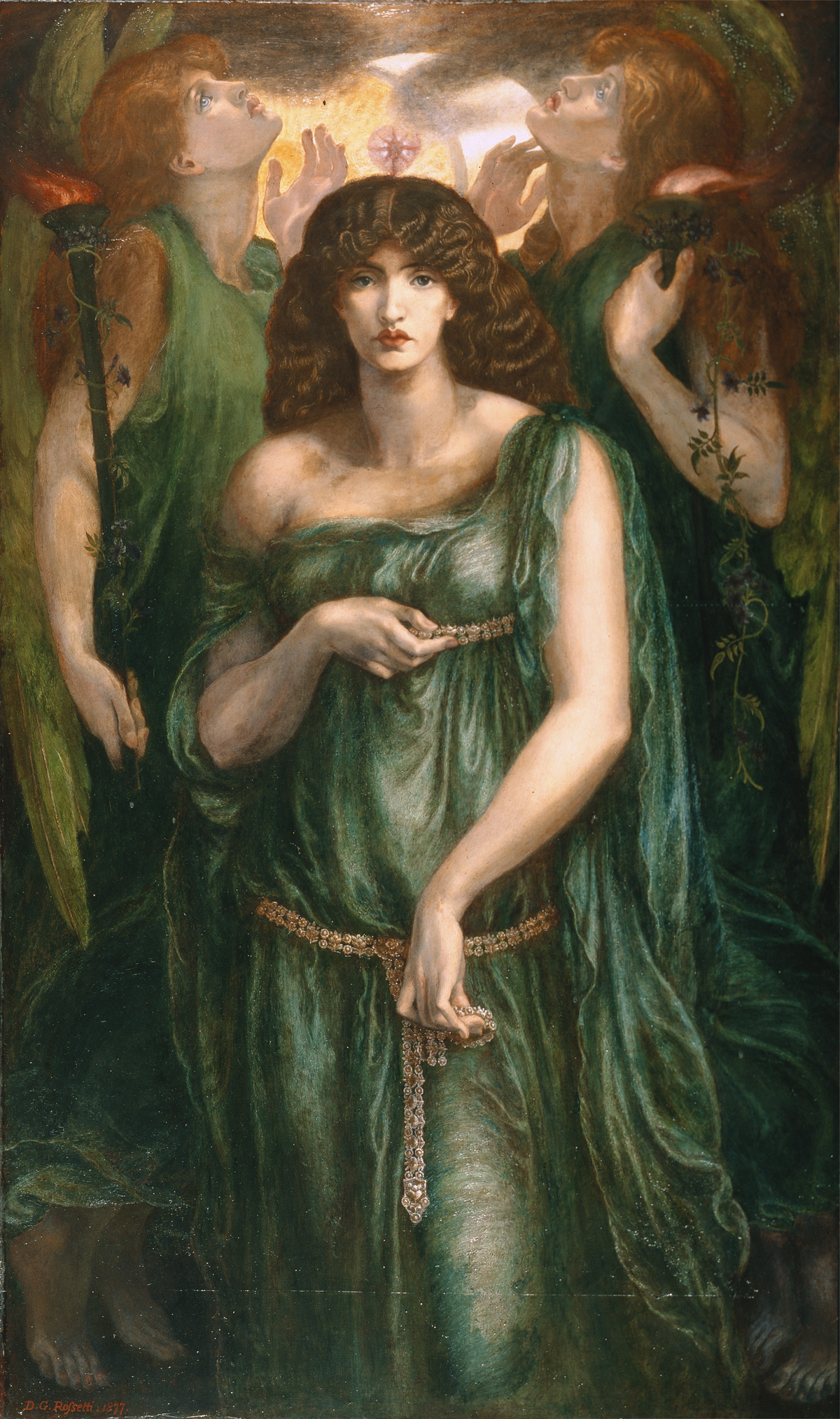

 Rossetti's chloral addiction and  mental and physical decline continued apace,  In pain due to a failed operation on hydrocele, Rossetti was turning into  a reclusive , suffering bouts of depression, psychosis and hallucinations.  He  almost died due to overdose of laudanum; mirroring  his late wife's overdose.  Experiencing faints, Jane struggled to pose for him. Venus Astarte ,  was the last painting she modelled for -  a startling unsettling image reflective of  Rossetti's psychological turmoil and angst. Jane finished their affair around 1876.

Recalling that she ended their meetings due to Rossetti's madness, Jane later recounted: 
Venus Astarte
  DG Rossetti Wikimedia Commons
"That Gabriel was mad is but too true, no one knows it better than myself"...When I found out that he was ruining himself with Chloral and that I could do nothing to prevent it I left off going to him – on account of the children". 

They remained good friends and carried on an affectionate correspondence. Rossetti seemed bereft without her, he wrote:  " No- one else seems alive at all to me now, and places that are empty of you are empty of all life....... You are the noblest and dearest thing that the world has had to show me". 

It was also a time of family anguish for Jane. Jenny, her eldest daughter, who had hopes of going to Cambridge or Oxford,  had suffered seizures and been diagnosed as an epileptic, her future  hopes  now blighted. Unlike the prevailing practice of the time, Jenny was not sent to an institution but remained in the family home , her care falling heavily on Jane.  Morris suffered considerable guilt believing Jenny  had inherited the condition from him .

 Celebrity Status 

 It's hard to say whether she's a grand synthesis of all Pre Raphaelite pictures ever made - or they a " keen analysis" of her - whether she's an original or a copy"  Henry James

Rossetti's portraits  endowed Jane  with celebrity status as a Pre-Raphaelite icon in her lifetime. Given her strong distinctive features,  dramatic hair, and distinctive fashion - wearing loose flowing dresses and beads instead of the prevailing corset and crinoline - she challenged previous concepts of female beauty, and was subject to much critical comment. Author Mary Eliza Hawe noted: "certain types of face, once literally hated,  (are) actually the fashion. Only dress after the Pre-Raphaelite style and you will be astonished to find that so far from being an "ugly duck" you are a full fledged swan". 

Deliberately or unconsciously Jane exuded a mysterious other-worldly aura and many writers found her intriguing.  Henry James noted Jane as " a dark silent medieval woman " an apparition of fearful and wonder intensity . . . a tall lean woman in a long dress of some dead purple stuff, guiltless of hoops (or of anything else)". For George Bernard Shaw , "She looked as if she had walked out of an Egyptian tomb at Luxor." 

In contrast , Angela Thirkettle , Burne-Jones's granddaughter, recollected Jane as a personality who was warm and sociable. "She was so easy to talk with and greeted anything amusing with a laugh that we still remember.. I can only say that Aunt Janey (as she was to us) was the very opposite of the ’strange moody beauty …".

 After Rossetti - Wilfrid Scawen Blunt


William Blunt
circa 1870 NPG
"I cannot make up my mind about Mrs. Morris, whether she is really clever or not. I watched her closely and I don't think she knows anything about painting but I like her whether or not, her connection with Rossetti makes her very attractive to me"   Wilfrid Scawen Blunt

After Rossetti's death in 1882, Jane embarked on an affair with  reputed womaniser Wilfrid Scawen Blunt,  diplomat  poet and  avid Rossetti fan. Jane's relationship with Rossetti was definitely part of her attraction for Blunt. Their affair is generally considered to have started around 1887 .  

 Whereas Jane had been a spur for Rossetti’s creativity emotionally and visually, Blunt recorded his affair in prosaic and dispassionate terms: noting the creaking floorboards as he stealthily tiptoed to Jane's bedroom at Kelmscott Manor, and how she signalled  her  availability for a nocturnal visit from him by leaving a pansy in his bedroom . 

According to Blunt,  Jane was “so silent a woman that except through the physical senses we never could have become intimate,”  .  Nevertheless the affair appeared to make her happy, and she confided in Blunt: "she told me things about the past which explain much in regard about Rossetti "I never quite gave myself", she said "as I do now". Their  on and off affair lasted for seven years until 1894, and they continued friends thereafter.  Despite her affairs, Jane and |Morris appear to have had an affectionate relationship. Morris asserting in a letter that "her company is always pleasant, and she is very kind and good to me"  and Blunt noted of Morris "he was a wonderful man.....,tender to his daughter and nice with her and his wife but with no thought other than work he had in hand .

There has been speculation that Morris by this stage may have fallen in love with Georgiana, the wife of Edward Burne- Jones but outside of a close friendship, there is no evidence of any affair or otherwise.

"What had taken place between her and Rossetti he knew and had forgiven....I used to think that he suspected me at times...even to the extent of jealousy"   Wilfrid Scawen Blunt on Morris

Fiona McCarthy has noted on Jane's extra marital affairs : "There is something horribly ironic about Janey's need to turn to two of the most notoriously honey -tongued philanderers of their age. Reading her correspondence with Rossetti and with Blunt,  it becomes obvious that their male bravado and sexual attentiveness give Janey a self confidence that Morris with his shyness and multitude of energetic preoccupations,  patently  did not. With  her lovers, Janey blossoms, becomes tender and even witty" .


Jane Burden Morris
 1904 Evelyn de Morgan
 

1896-1914

Morris died in 1896, and Jane outlived him for another 18 years. She died  in 1914 aged 74  just before the outbreak of World War 1 .  Concerned for her daughters' future; her  epileptic daughter Jenny requiring nursing care and May  now divorced, Jane purchased Kelmscott Manor a few months before her death .  Her daughter May Morris lived there until her death in 1938 , and became a prestigious embroiderer and designer.  Like her husband,  Jane was buried in  St George’s churchyard Kelmscott

 After Morris's death, she contributed to his legacy on  his causes such as the Society for the Protection of Ancient Buildings and the Kelmscott Press

" Why should there be any special interest in me when I have never done any special work"  queried Jane.  As an iconic face,  her influence and contribution to Morris & Co's work and designs,  and as a member of the Pre-Raphaelite circle, Jane Morris is assured of continued interest particularly given her remarkable life story. In her book Wives and Stunners, Henrietta Garnett sums her up as :

" an essentially passive, likeable yet elusive character... hard to fathom. Despite her lack of education, she was intelligent, had become exceptionally well read, and had what her contemporaries referred to as "presence"...... Her relations with Morris never developed into that tender intimacy which results from years of close union..... It is difficult to be convinced that although, like most people,  she enjoyed admiration and adulation, she was ever truly intimate with anybody."  


Rossetti's Day Dream -The Turf Tavern
by Jane's birthplace in St Helen's Passage, Oxford


https://janeburdenmorris.blogspot.com/2021/08/jane-morris-mrs-morris-blue-silk-dress.html

The Girl from Hell's Passage - Jane Morris

  Jane Morris in 1857  DG Rossetti  Wikimedia Commons A one time flower girl whose face became an iconic image of Pre-Raphaelite art , Jan...